In the last three years we’ve witnessed books emerge from the pandemic, their writers grappling with a unique universal experience through language and literature. Zadie Smith’s Intimations is a slim but immediate account of the early days of the pandemic and of a life altered by lockdown, while Deborah Levy’s most recent novel August Blue sees the virus lurking on the periphery as characters remove their masks and discuss vaccination appointments. Whether in the foreground or the background, the pandemic has seeped into contemporary works and it is difficult to imagine a text set in the last few years with no mention of symptoms, testing, or isolation.
At a time of seclusion, many of us also gravitated to dystopian fiction published prior to the pandemic that dealt with viruses and contagion such as Emily St. John Mandel’s Station Eleven and Ling Ma’s Severance. These novels gained a new relevance as they seemed to have eerily predicted our new reality. We are constantly turning to literature and to authors to find recognition in our individual and shared experiences—books have always made us feel less alone.
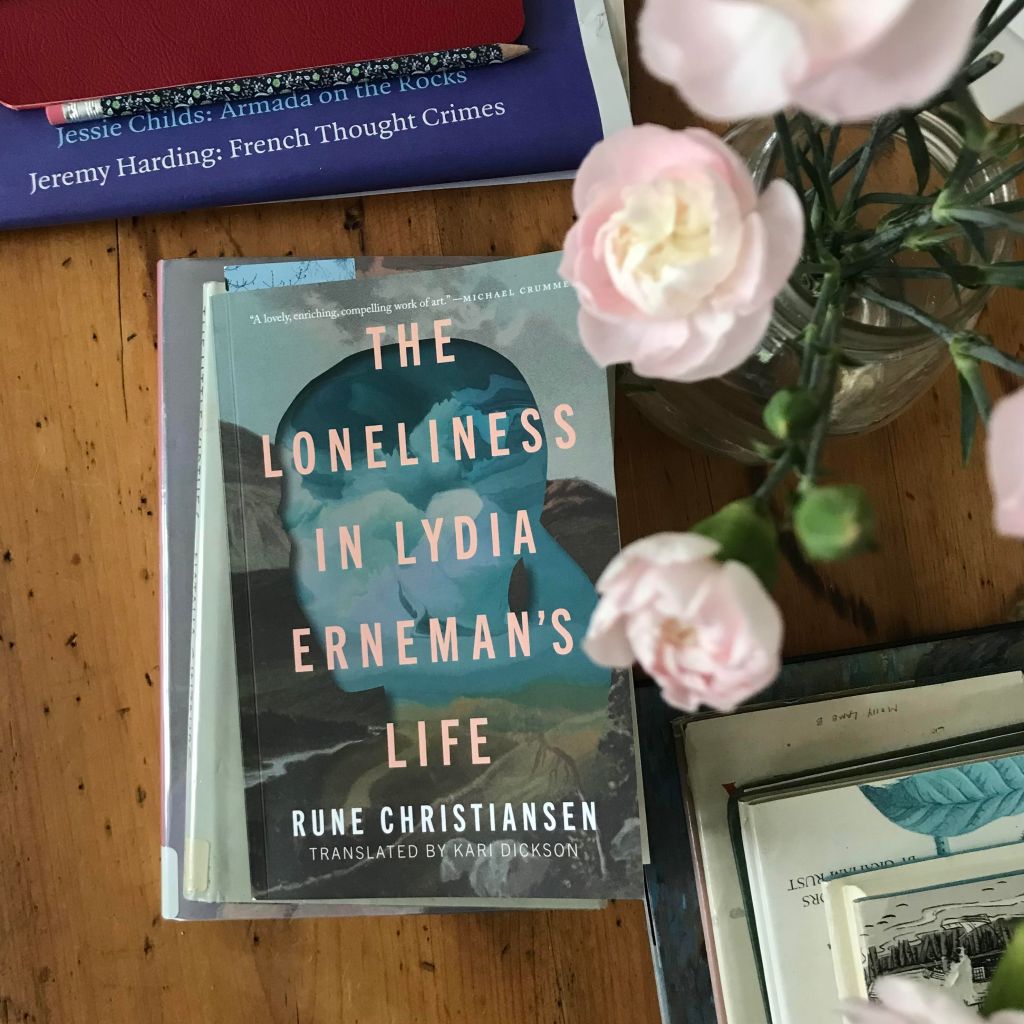
As we ease back into a more “normal” way of life with the pandemic still fresh in our minds and in our bodies, we are bound to seek out books for our present needs, ones that remind us of what it means to be alive and human, and how it feels to once more be members of a society. Originally published in Norwegian in 2014 and translated into English by Kari Dickson for the first time this year, Rune Christiansen’s The Loneliness in Lydia Erneman’s Life is in many ways a book for our times. It is a meditation on solitude and loneliness, an intimate study of connection and human relationships, and ultimately how one character navigates her newfound need for connection after living a life of contented solitude.
As an only child growing up in Northern Sweden, Lydia Erneman was accustomed to being alone and to feeling lonely. She filled her days with her love of animals and developed a deep empathy for and an awareness of her natural environment and all its living beings. After having left her family home to pursue veterinary studies, we are introduced to Lydia as she settles into her new life as a vet in rural Norway.
The year passed, time carried with it a unique lightness that could not be smothered. Ordinary everyday life played on repeat—her work, the animals, the household tasks, and the changing weather—everything recapitulated, everything renewed itself. And then, eventually, spring returned. One Sunday morning, Lydia was woken by the magpies outside. She had soot on her eyelids. She switched on the bedside lamp and held it up. Her breath created small clouds that quickly evaporated.
Christiansen constructs a seemingly simple novel around Lydia’s “ordinary everyday life” of work and activities but heightens these rather mundane tasks with her inner life, weaving her thoughts, memories, and sensory experiences into the narrative. We accompany Lydia through all four seasons, we head out with her in the morning and undress in the evening, we visit her unchanged childhood home only to see the changes in her aging parents, and we sit at unfamiliar dinner tables longing for the peace of our own abode. As Lydia settles into her new routine and her new home, we see her grow restless with her own solitude as she begins to crave human connection.
Even though it was probably nothing more than a summer flu, she was overwhelmed by the wish that someone was with her. She knew perfectly well that loneliness was not necessarily an evil. Twosomeness was not always based on love, and what would such a connection actually give her?
These moments of vulnerability, prompted by mild illness and grief at the loss of a loved one, leave Lydia to question and to reassess her own comfort with solitude and loneliness. While Lydia’s isolation is largely driven by choice and by habit rather than a government-enforced lockdown, her intermittent discomfort with loneliness will be all too familiar to today’s readers. As Lydia ruminates on these questions of “twosomeness,” Christiansen introduces other characters into her life that represent varying forms of love and human connection, whether this be between parent and child, between coworkers, between romantic partners, or between two people simply caring for one another. These new relationships begin to form around Lydia and we witness a delicate balance being struck between solitude and togetherness as our protagonist continues to guard her personal time but opens herself to new connections—fostering a new sense of self and happiness.
The novel itself is composed of brief chapters that are more akin to vignettes, each one introduced by a heading that acts as both a title and a guide to the piece. The form of Christiansen’s work blends characteristics of a novel and a collection of poetry as the collected vignettes are both tightly linked and standalone pieces of writing. These interconnected moments, snapshots, and memories create a layered narrative that progressively unfolds and draws us further into the protagonist’s life. This gradual unfolding brilliantly parallels Lydia’s protection of her space, time, and solitude—we are getting to know Lydia slowly, intimately, and on her own terms.
She stopped and stood quietly by the edge of a small lake, occasionally lifting a hand to wave off an insect, and a couple of times she reached out toward a dragonfly, not to catch it, more in recognition of a connection there in the dusk. That two creatures should share the same moment, be it ever so fleeting, was certainly not insignificant.
Amongst the more concrete references to Lydia’s life, from her childhood to her work as a vet, are minor but weighty experiences that are crafted with such immediacy. A seemingly inconsequential scene where our protagonist stands at the edge of a lake reaching out to a dragonfly speaks volumes to themes of loneliness, connection with other beings, and love and loss as her engagement with this insect is so brief. While the vignettes allow these subtle moments to take centre stage, it is Christiansen’s prose that bring them to life through measured sentences that are suffused with depth, significance, and emotion. Coupled with the layered narrative, the layered prose deepens our connection to Lydia and in the end, we find ourselves somewhat tethered to Christiansen’s unforgettable protagonist.
As the title suggests, loneliness and solitude are ever-present in Lydia Erneman but they are never vilified. Instead, they are explored as something normal if not necessary in life. While solitude and togetherness are often thought of as opposites, Christiansen draws them closer together in a display of peaceful coexistence that suggests a fluctuating balance between the two is far better and more beneficial than one without the other.
After years of a pandemic that forced many of us into isolation, Lydia Erneman reminds us of the importance of community and companionship, and the value in nurturing a vibrant inner life that relishes time spent alone. Christiansen’s novel speaks to us so clearly nearly a decade after it was first published and it will continue to do so for many years to come, as all timeless novels do.
______________________________
I am very grateful to Zg Stories and to Book*hug Press for sending me a copy of this brilliant book, it was an absolute joy to read!
 Sydney K Erickson
Leave a comment