“After a while, being ambitious means having to sift out the few values we feel like keeping and toss the rest, or twist them to suit ourselves. Even the tiny handful of values that remain just get stuffed into the attic of memory, like some old thing bought and used up long ago. What are buildings made of? In the end, money and power. They alone decide which memories will take shape and survive.”
from Hwang Sok-yong’s At Dusk, translated by Sora Kim-Russell
Park Minwoo, born into poverty and now the director of an architectural firm, has just completed a lecture. As he makes his way into the audience, a woman approaches him and hands him a piece of paper. The note contains a phone number and a name he immediately recognizes: Cha Soona, a childhood friend and someone he once loved.
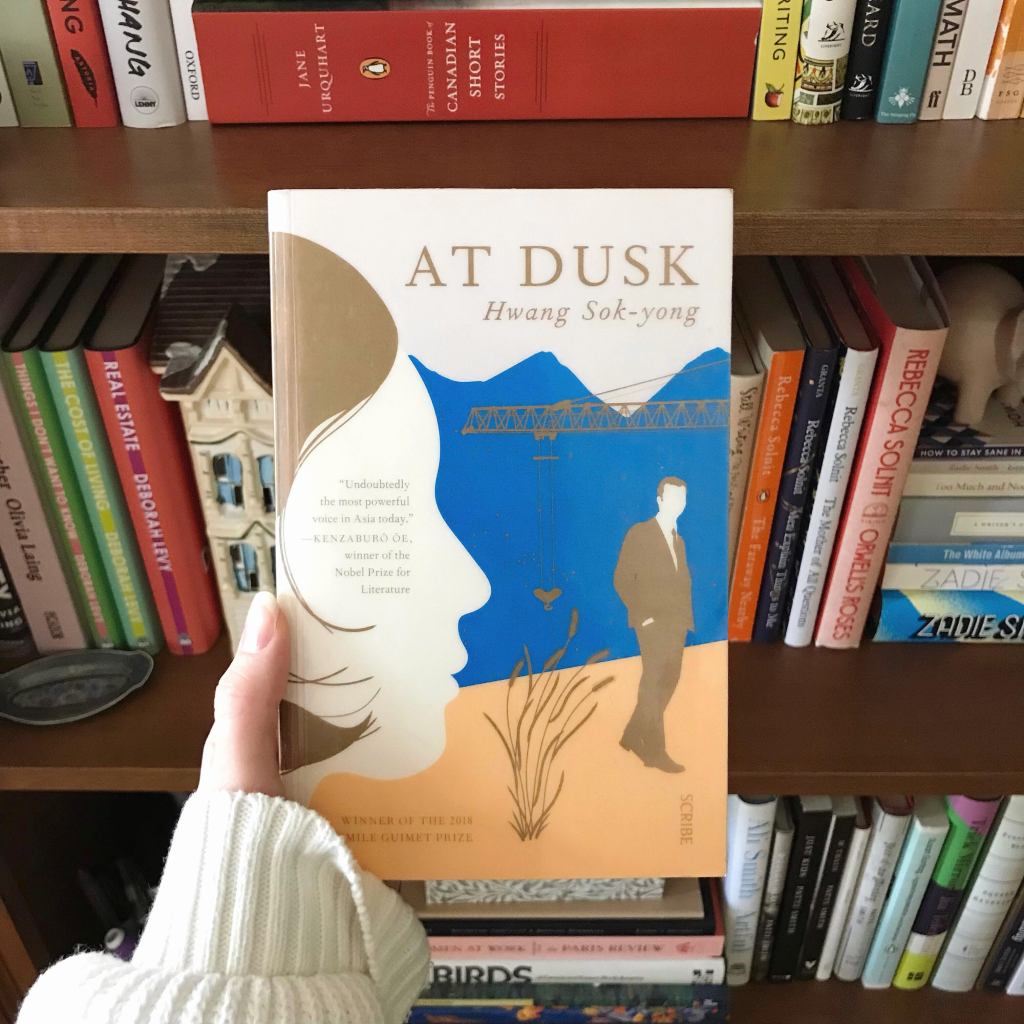
And so begins Hwang Sok-yong’s At Dusk, a novel set in South Korea that examines Korea’s past and its lasting effects on the present through the memories and experiences of individuals, families, friends, and communities. This brief encounter in the lecture hall allows Minwoo to reconnect with Soona and prompts him to wade through his own memories, to revisit childhood friendships, and to retrace certain experiences that have stayed with him well into adulthood. Through Minwoo’s written communications with Soona, we are offered a dual narrative of these characters’ shared experiences and two seemingly different storylines that constantly converge and ultimately complete one another.
Hwang’s novel captures a country that is rapidly moving forward and examines the people and the places that are left on the periphery of this quickly modernising society. As our protagonist is drawn back to his childhood and to his memories of growing up in a poor neighbourhood, he is forced to question the role he played in this wave of modernisation—a wave that demolished neighbourhoods like the one he grew up in, rendering them nonexistent or unrecognizable.
At Dusk is not only a brilliant study of South Korea’s modernisation, but it is also a study of memory and of place, and how entwined and crucial they are to one another. Filled with memorable characters, Hwang’s novel is ultimately driven by a handful of distinct voices that you’ll surely miss once you’ve reached the final page!
 Sydney K Erickson
Leave a comment