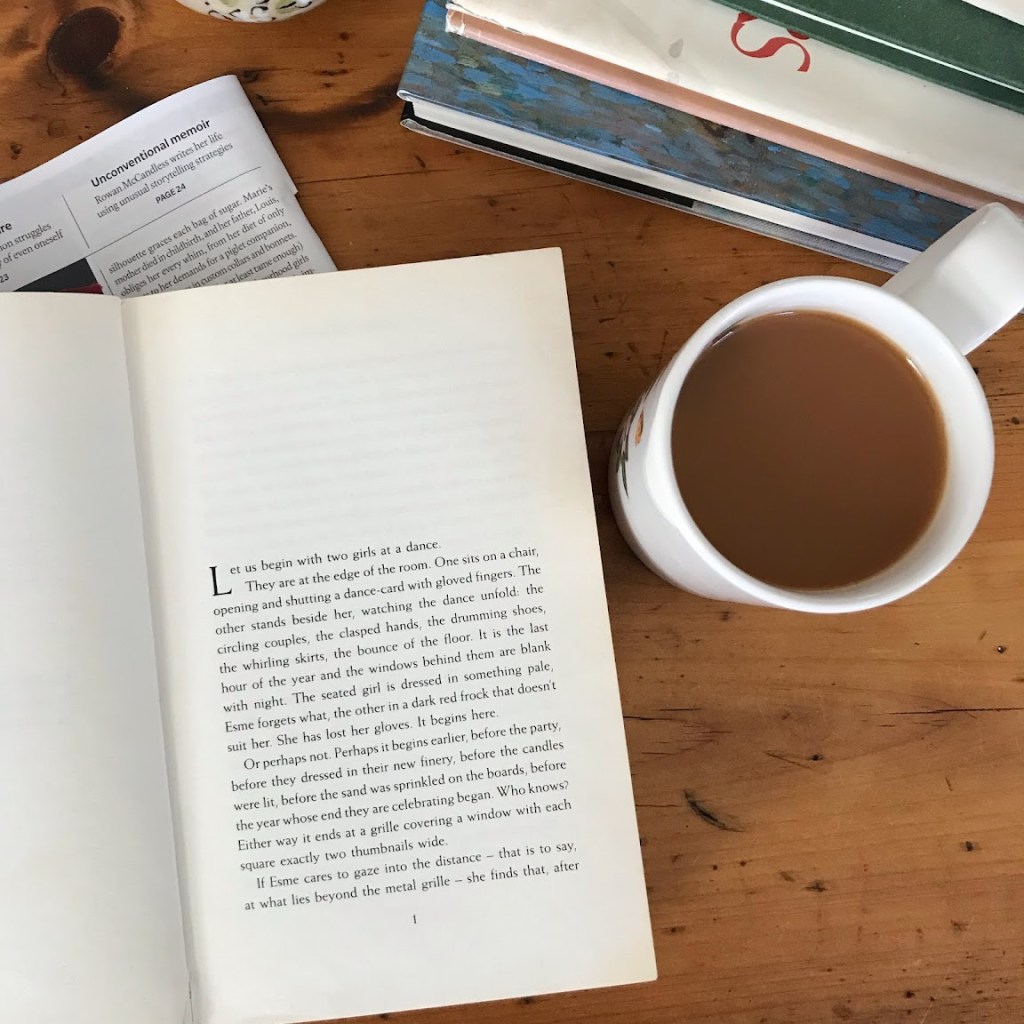
“Let us begin with two girls at a dance.
They are at the edge of the room. One sits on a chair, opening and shutting a dance-card with gloved fingers. The other stands beside her, watching the dance unfold: the circling couples, the clasped hands, the drumming shoes, the whirling skirts, the bounce of the floor. It is the last hour of the year and the windows behind them are blank with night. The seated girl is dressed in something pale, Esme forgets what, the other in a dark red frock that doesn’t suit her. She has lost her gloves. It begins here.”
from Maggie O’Farrell’s The Vanishing Act of Esme Lennox
A few weeks ago, a patron returned this book to the library and as I placed it in the trough to be put away with the other novels, I skipped to the first page and read these opening lines. I reminded myself that I had far too many books at home, but I brought it back to my desk anyways because there was just something about the first paragraph that drew me in. Maggie O’Farrell’s writing spun an intricate web around me and I was happily caught in this novel, surrounded by its characters, until the very last page.
It is the 1930s and the Lennox family is returning to Edinburgh from India with their two daughters, Esme and Kitty. While both girls are being prepared for their entrance into society and for marriage, their parents and tutors can’t quite seem to get a hold of Esme—she is stubborn and unpredictable, and wants nothing to do with the path her parents have laid out for her. To her family, Esme is seen as disruptive and interfering. Her behaviour increasingly tests both their patience and their position in society, and the moment it reaches too far, they decide to send her away.
Decades later, Iris Lockhart receives a letter and a phone call about her great-aunt, a Euphemia Lennox, who is due to be released from a psychiatric unit. Iris is adamant that her grandmother was an only child, but after sifting through the paperwork and after meeting Esme, as she prefers to be called, she can’t deny their relation. Iris is left wondering how she has never heard any mention of Esme, and so we embark on a journey with the characters as they all try to retrace their steps and their family’s history.
The Vanishing Act of Esme Lennox delves into a family’s past and investigates the lasting effects of secrets kept for generations. Themes of loneliness and trauma run throughout the narrative while O’Farrell turns a critical eye on the stigma surrounding women’s mental health and the treatment of women who were once deemed ‘unconventional’.
The novel is as much a story about memory as it is a study of memory. As the narrative unravels without interruptions from chapter breaks or sections, we move seamlessly between three characters’ perspectives and their own recollections. This format might feel confusing and unreliable at times, but it captures the fragmented and disjointed nature of one’s memory so perfectly. This is a far-reaching novel, both in theme and narrative, that is so masterfully drawn together.
Before you sit down to read, I urge you to get a pen or pencil, not only will you want to draw up a family tree as you go along, but you may want to underline a few breathtaking passages so you can return to them later!
 Sydney K Erickson
Leave a comment