“Each class took turns buying the week’s flowers for morning assembly. […] My class’s turn, that first term, came on a frosty morning in December. I had to get up at dawn, before anyone else was awake, and find my way alone to King’s Cross, where I changed to the Piccadilly Line and on to Covent Garden. […] It was still early when we got to school, where our next task was to arrange the flowers in the massive vases on the stage. Whatever the educational value of our expedition, it had been a bonding exercise, which might have been the point. When the bell eventually rang, and we took our seats with the rest of the school, we were convinced the flowers had never looked better.”
from Linda Leith’s The Girl from Dream City: A Literary Life
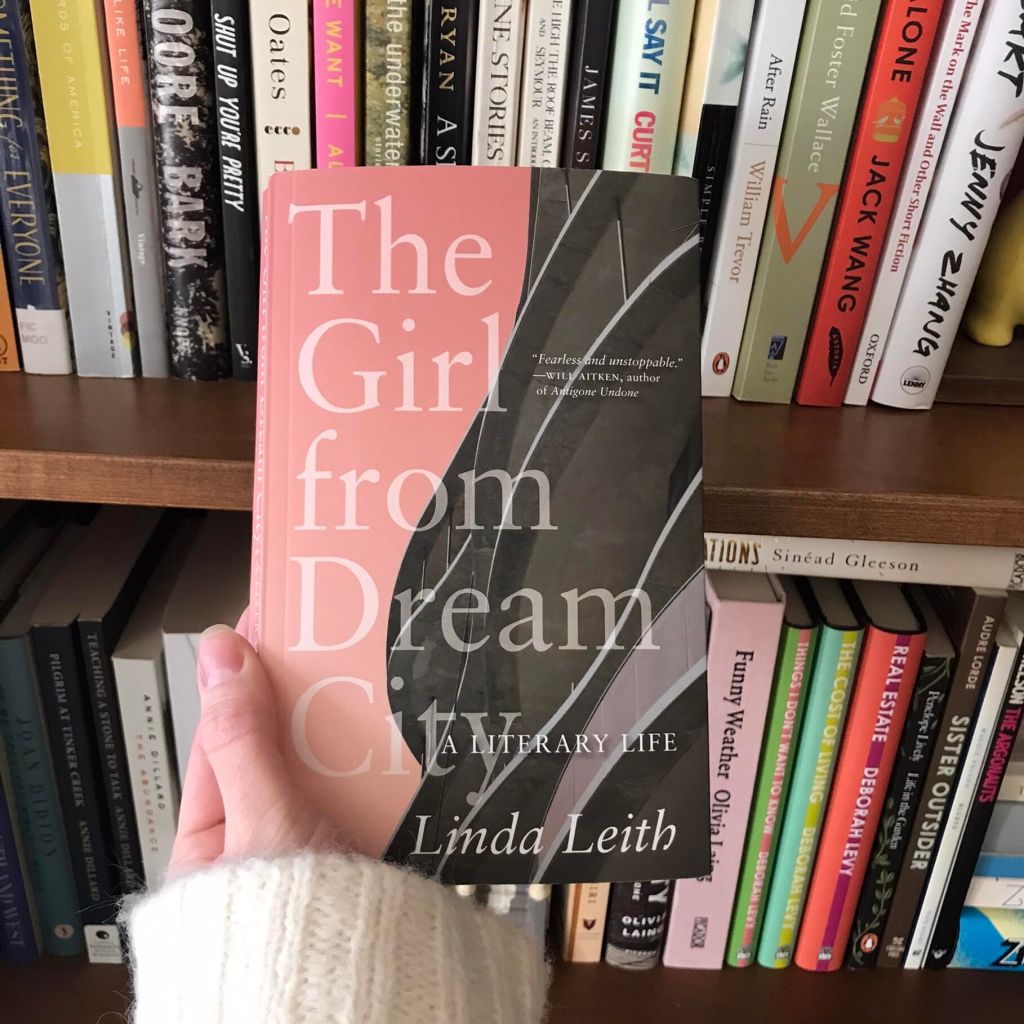
As children, we dream of what our lives will look like and what they will be like as we try to catch a glimpse of our future, anxiously awaiting the freedom and independence of adulthood. These dreams often change and evolve, but some remain untouched and fuel the work, the time, and the determination needed to attain them. In many ways, Linda Leith’s memoir The Girl from Dream City: A Literary Life is about the dreams that last and that are carried with us into adulthood, and it is about a lifelong pursuit of a life once imagined.
While Leith’s memoir follows a set linear trajectory, it extends across countries and dips into discussions of what it means to be a woman in the literary community, and later, what it means to be a mother with a literary career. Born in Northern Ireland and raised in various European cities, Leith’s early memories are often marked by the birth of her brothers and sisters, and the taut relationship she had with her father. As she revisits these more painful moments, often through discussions with her own mother, she begins to unravel her father’s psychiatric breakdown and his own struggles with mental illness. In these early chapters, we also catch glimmers of an early reader who is surrounded by language, culture, and literature from a very young age. We witness Leith attentively listening to the lyrics of her grandmother’s songs and studying the authors on her mother’s bookshelves. As we continue to read, we recognize how essential these literary moments and memories are to a young Leith, and how they have come to frame and drive her own literary career as a writer, an editor, a translator, and as the founder of Montreal’s Blue Metropolis Literary Festival.
The Girl from Dream City often follows the recognizable framework of an autobiography, but there are moments that deviate from this more informative and recollective tone. It is in these moments that we are introduced to Leith as a novelist and I found these passages to be particularly compelling. As Leith recalls poring over her Latin tests with eagerness and excitement, we see a young translator at work; and when she observes a young woman in a bathing costume at the beach, simultaneously recognizing the changes in her own body, we see a novelist’s eye at work. In these moments, we not only witness the initial sparks of Leith’s literary life, but we are also given a multifaceted view of an author that is at once an essayist, a memoirist, and a novelist. When reading, my only wish was that these passages were given the space to play out to their full potential instead of being cut short for the progression of the narrative, but it was a delight to find them scattered throughout the book.
Leith’s The Girl from Dream City is a compelling and engaging memoir that traces the lifelong influence and inspiration gained from being surrounded by books, writers, language, and literature—perfect for anyone with similar dreams of one day living a literary life!
______________________________
I’ve looked forward to reading Leith’s memoir since I read a review in Quill & Quire and I am grateful to Ryann and those at ZG Stories for sending a copy my way!
 Sydney K Erickson
Leave a comment