“You have to stop this, she said.
Stop what, he said, we’re not doing anything. She wanted to correct him. There was no we. There was he the subject and her the object, but he just told her look, there’s no point getting worked up over nothing.”
from Natasha Brown’s Assembly
These are the opening lines of Assembly, Natasha Brown’s one-hundred-page debut novel that leaves you wondering how one can fit so much in so little space, and how one could possibly capture this book in a single review. From the first page we are swept into the fragmented and jolting narrative that moves from scene to scene without warning—from a doctor’s appointment to the protagonist sharing a meal with her male colleagues, from a hateful and disturbing encounter on a solo walk in London to a garden stroll that proves to be just as uncomfortable and threatening. If you were to flip through this novel, you would notice the breaks within the text, forcing space between character interactions and moments of dialogue that visually complement the fragmented writing but also introduce pauses before and after the striking scenes that mark the novel. As readers, we follow our protagonist as she prepares to attend a party at her boyfriend’s parents estate but this thread of a storyline is constantly interrupted by the protagonist’s own critical and intuitive eye as she begins to deconstruct the life she has carefully assembled and to question the pieces she has been using to assemble it. Brown has composed a unique and original narrative that takes a scalpel-like precision to the experiences of a Black British woman and to the prevalent, systemic, and at times subtle ways racism and injustice seep into contemporary everyday interactions on the street, in the workplace, and at home.
The scenes and exchanges we witness in Assembly spark questions and thoughts in the protagonist as she begins to unpack and reevaluate her own reality and what has led her to this point. Throughout the novel, there are an accumulation of moments in which she mentions that she has always done the right thing, that she has obtained a remarkable education, that she has been a reliable employee, that she has become self-sufficient and self-reliant, that she has never made a fuss, but has instead remained quiet and respectful—guidelines that were not her own but were instead drawn up to attract the least amount of attention and to fit a definition of success written by a society that routinely made her feel unwelcome and unacknowledged.
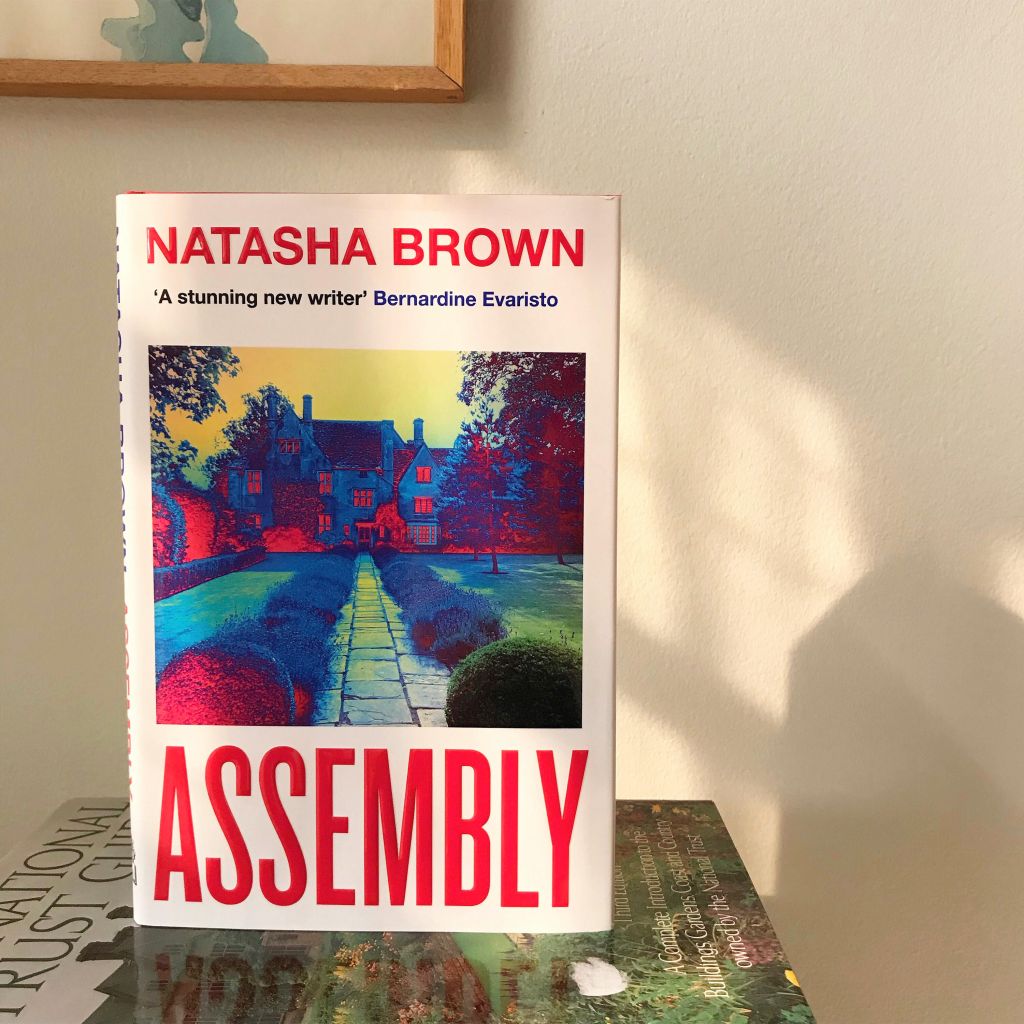
While a short read, I do think Assembly deserves a few more rereads in order to capture every insight and every moment, and to fully appreciate the breadth of topics addressed and questions posed. I was initially drawn to the plot and the cover of this book but I don’t think any review or description could do Brown’s novel justice—a very exciting debut!
______________________________
On another note, I did a little search as I recognized the building on the cover of Assembly and it is indeed a shot of Avebury Manor, a National Trust property, in a striking modern and quite confronting edit—I love this UK edition!
 Sydney K Erickson
Leave a comment