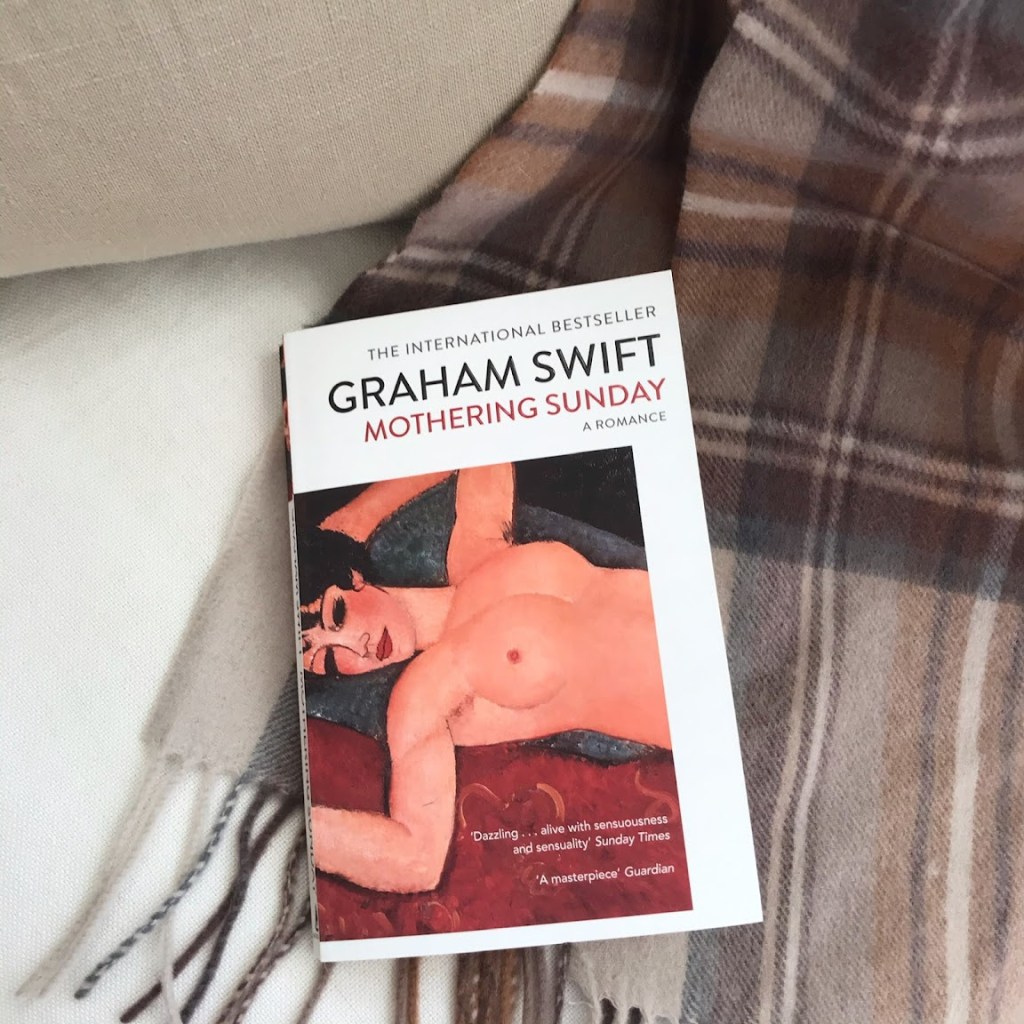
“As if the day had turned inside out, as if what she was leaving behind was not enclosed, lost, entombed in a house. It had merged somehow—pouring itself outwards—with the air she was breathing. She would never be able to explain it, and she would not feel it any the less even when she discovered, as she would do, how this day had turned really inside out. Could life be so cruel yet so bounteous at the same time?”
from Graham Swift’s Mothering Sunday
I added this book to my little library when the weather was warming up in the UK, when I had a dissertation to work on, and when I was still unaware of just how much I would love Spring in Oxford.
Mothering Sunday caught my eye as I had heard that it is largely set over the course of a single day and I’ve always loved and admired how writers can stretch out a meagre twenty-four hours!
At the opening of the novel we find ourselves in 1924 with our protagonist Jane Fairchild, a twenty-two-year-old maid in the English countryside. While the majority of people are visiting their mothers on this Mothering Sunday, Jane is meeting her lover Paul for one of the very last times before his wedding. What follows is a story composed of vivid scenes from that one Sunday, we are given glimpses into a younger Jane, and are introduced to a much older Jane who is reflecting on her life, which spanned much of the twentieth century, and on that one day in March.
After reading Swift’s Mothering Sunday, I can say with complete certainty that the book is so much more than ‘A Romance’ or a sensual tale as most of the blurbs suggest. This novel deals with female desire and sexuality, with contraception, with the unstable status of English Countryside homes and their families and servants after the First World War, and with the social barriers that fostered secrecy in both relationships and households. The one thing I absolutely loved about this book was the sense of time: how it jumped and slid across decades and how it seemed nonexistent and suspended in the most brilliant of scenes. Given that this novel is not divided into chapters or into parts, the fluidity of time is uninterrupted as we move from minutes, to hours, and onto decades within its pages while the narrative itself holds our attention so firmly until the very last sentence.
And if I haven’t been too clear over the last few paragraphs, yes, I highly recommend this book, and I will definitely be rereading it sometime soon!
 Sydney K Erickson
Leave a comment