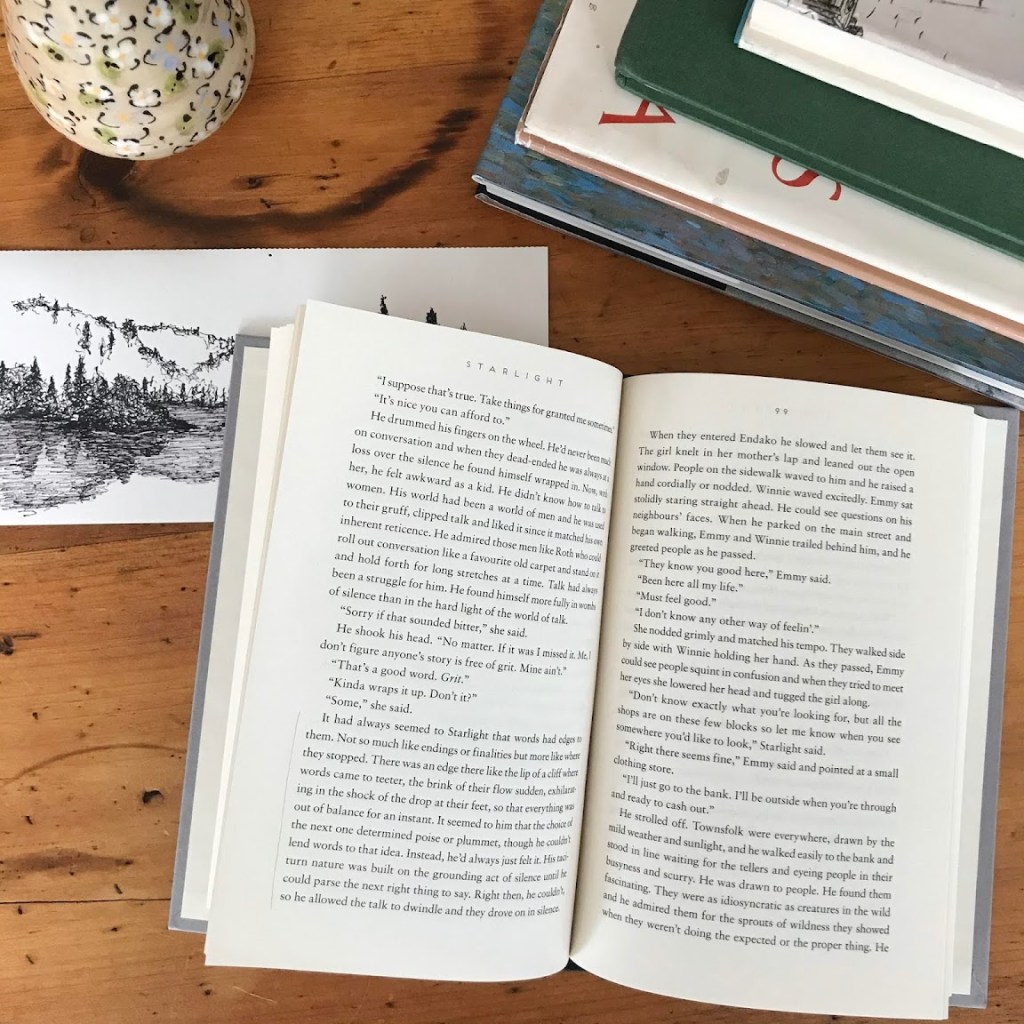
“It has always seemed to Starlight that words had edges to them. Not so much like endings or finalities but more like where they stopped. There was an edge there like the lip of a cliff where words came to teeter, the brink of their flow sudden, exhilarating in the shock of the drop at their feet, so that everything was out of balance for an instant. […] His taciturn nature was built on the grounding act of silence until he could parse the next right thing to say. Right then, he couldn’t, so he allowed the talk to dwindle and they drove on in silence.”
from Richard Wagamese’s Starlight
I remember the first time I read the jacket of Richard Wagamese’s Starlight. I was still working at the library and I held the unfinished novel in my hands, making a mental note to add it to my ‘wish list’ once I finished work – it’s been on my list ever since and I am so happy I finally got around to reading it back in December.
The first few chapters alternate between our protagonist, Frank Starlight, and a mother, Emmy, and daughter, Winnie, not too far away who are running from a dangerously abusive relationship. Wagamese sets them as two separate points on a map, having them inch closer and closer together as we move further into the novel. There is a tension and an eagerness to have them meet and to bring all three of them together as we read through each page. Wagamese builds towards this first encounter and what follows is a story of family, friends, and the home one finds in different places and faces than the ones they grew up in and with. It is a story of connection and communication, of language and dialogue, of the intimacy that comes from sharing a moment or a few hours of silence, and the intuitive connection formed with the natural environment and those we come to regard as family.
Richard Wagamese, an Ojibway author from the Wabaseemoong First Nation in Northwestern Ontario, passed away in 2017 before completing this novel. The story of Starlight, Emmy, and Winnie certainly comes to a sudden halt, but the inclusion of certain materials following the novel offers somewhat of a conclusion without grounding it in one specific ending. The publisher has included the end of a short story and an essay by the author, as well as hints of what Wagamese had in mind for the novel, which were pieced together from what his friends recalled from their own discussions with the author. We see the potential roots of Starlight in one of Wagamese’s stories and one of his essays, we are able to trace some of the qualities of these works towards the novel, which seems to brilliantly reveal the weaving and interweaving of creative written works in this one final unfinished novel, Starlight.
I read Wagamese’s Starlight well over a month ago in one sitting, in one ‘this book is unputdownable’ moment, and I still think about the characters and the family and friendship they found in and amongst themselves.
 Sydney K Erickson
Leave a comment