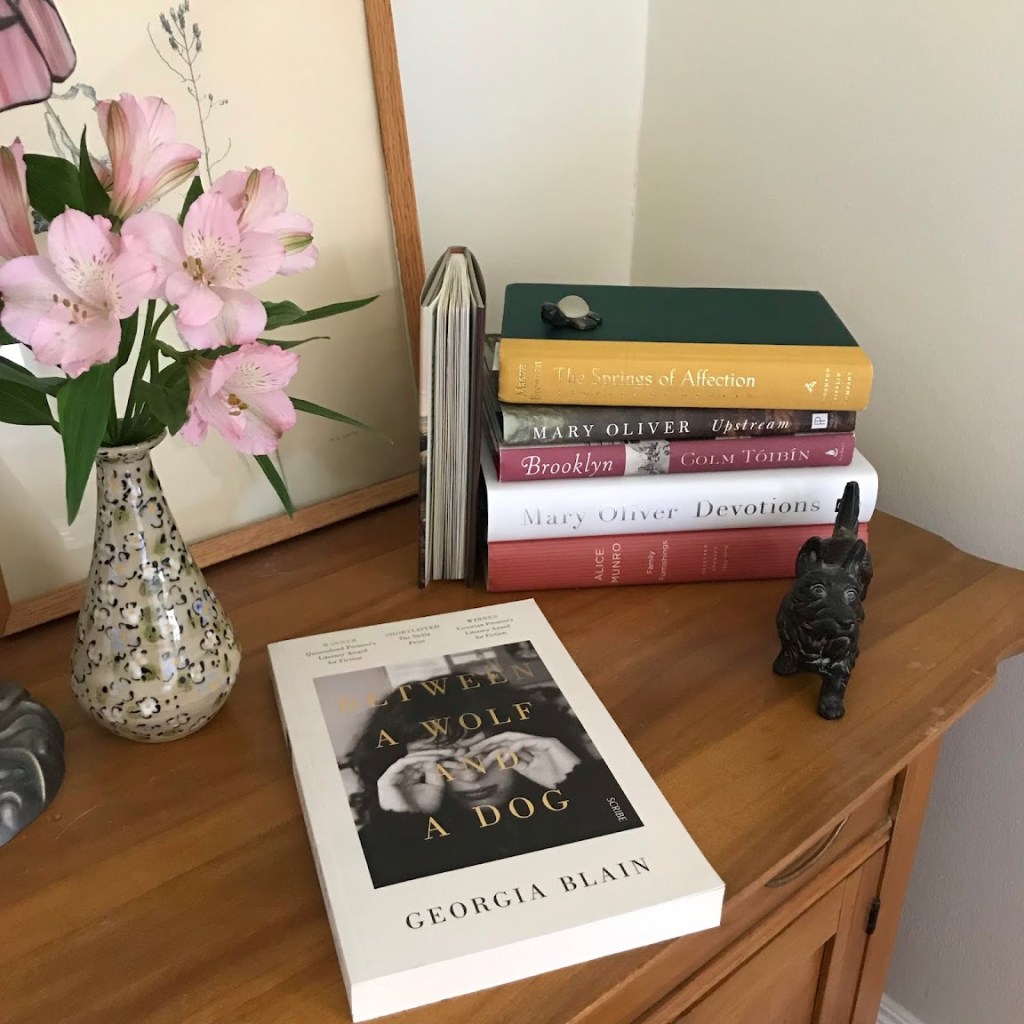
“This is the dream: Lawrence is alone. It is not quite dark, between a wolf and a dog; a mauve light is deepening like a bruise, the cold breath of the wind a low moan in his ear.
He stands on what feels to be the highest point in a landscape that he knows to be desolate and barren, although it is too dark for him to see. Hills roll away, dry grasses beaten low by the weather; pocked boulders, dappled with creeping lichen, appear to tumble, heavy, down a steep slope.
Is it breathing he hears? Or just the night sigh?”
This passage opens Georgia Blain’s Between a Wolf and a Dog, a novel set within the twenty-four hours of a single rainy day, interspersing this ‘present’ are parts that glimpse into the past that holds an immeasurable weight, a gravitational force that dictates the characters’ reality. As readers, we come to the story as Lawrence experiences the landscape in his dream: we can make out the subtle outlines, the possible figures, and the whisperings of things past as they form our understanding of this ‘now.’ Thinking of the analogy of the ‘onion,’ we are given parts of the very core and as we move through the novel, smaller, larger, medium, smaller, and crucial pieces are added to this centre. We are not left with a whole and complete onion at the end, we have between our hands a story of a fractured, perhaps irreparable, family and marriage, threatened to be reassembled through grief, as families often unwillingly and awkwardly gather when a member is lost.
The brilliance of this novel rests in its simplicity, in not questioning the reader’s intelligence, but rejoicing in it, and in making a whole story out of a day. At the very beginning, we are introduced to Ester: the mother, daughter, sister, former wife, and family therapist, as she begins her day by checking her appointment diary. As she moves from one meeting to the next, we accompany her, and so our understanding of this single day is anchored by her schedule. Time, memory, and experience, are subjects and themes dealt with in the novel, and when reading, I couldn’t help but think that while the past tends to dictate the present, it is never a guarantee of what is to come. In other words, one’s happy childhood does not guarantee a happy family life or unit later on, just as the events of a single day may determine peoples relationships three years from then. This effect of time and of the past seem to have differing holds on the future, it is at once powerful and powerless.
Between a Wolf and a Dog investigates this particular dichotomy within the theme of time. As the day progresses and as we move into the past momentarily through different passages, we begin to colour in the outline we once saw, the things we thought we could identify are now grounded more firmly, and our assumptions of the characters’ pasts are confirmed and rendered with more detail. These moments of ‘clarity’ have an earthquake-effect: the ground suddenly shifting and shaking to reveal the bones and the structures of interiors and we are left with the crumbled and the exposed as it informs our understanding of this family’s reality.
Blain writes with a firm understanding of her characters, as if she has known them all intimately and personally. She does not rush through scenes, but instead grapples with every moment, shaking it of the unnecessary and moving straight to its core, which is often the relationship between individuals, and the result is an untouched and unaltered communication of these relations. We run through the rain with the characters, wait for the downpour to stop under an awning, and watch the raindrops stream down our window as it blurs and impedes our vision while drenching and cleaning our surroundings. In the moment, this rain offers anything but clarity, but when it stops, it has refreshed what and whom it has fallen on – this novel is no different, as you stumble through it, trying to find your way through this unknown setting, you begin to see more easily as things reveal themselves or are illuminated, and you are left with a novel that has just stormed through a downpour: a story that, as it begins to dry, is glistening, harsh, pure, and raw.
 Sydney K Erickson
Leave a comment