At the age of twenty, I moved into my own place and brought a kitten, Gertrude, with me, who I had adopted two weeks prior to that big day, all of my belongings, and my collection of about three-hundred books. I packed them, carried them up four flights of stairs with the help of my parents, and unpacked them. I had books that were well-loved: Hemingway’s The Snows of Kilimanjaro, some classics that I hadn’t, and still haven’t, gotten to yet: Jane Eyre, and books that had been given to me over time, as gifts, or passed down from another generation. I chose a shelf next to the fireplace, the one I haven’t burnt anything in because I have a fear that something disastrous will result from it, or that somehow a squirrel will end up jumping through my place and unintentionally becoming the centre of attention for my now three year old cat. This shelf was for the “old books,” as I call them, ones that belonged to my grandfather and to a neighbour that lived across the street, who, when leaving behind the home which he not only grew up in, but lived in for his whole life, told me to “take any of the books you want.” Some have leather covers, the pages so thin that you can’t quite “flip through” them, they have that smell of collected dust, winter evening fires, and days spent on the shelf bathed in sunlight. In others, I found a love note that had been crossed out, a drawing of an airplane at the back of a Shakespeare play. All of the books were carefully placed in the living room, organized alphabetically and my current reads rested on my nightside table by my bed.
A few years have passed and my collection has grown to over five-hundred books, a number which doesn’t bother me, but one I suddenly became aware of when I decided one day last August to re-organize all of my books. This meant taking them all off the shelves that they had come to know, wipe down the shelves with a damp cloth, create piles for every genre and then find a way to separate them, distinguish them from one another. Fiction is the largest collection and so it took the mantle and bookcases that had been installed when the building was first built. On one windowsill, all of Hemingway’s work that I had was neatly organized, on the next: Short Fiction, the one beside that: Memoir and Biography, and finally, Non Fiction. On a bureau, I placed my poetry collection, in a separate bookcase: Literary Criticism and Drama, and finally, in my bedroom, all authors and books that I cherish, love, and return to over the course of the year: Alice Munro, Mary Oliver, Joan Didion, Patti Smith, Donal Ryan’s The Spinning Heart, Colm Toibin’s Brooklyn, and Lorrie Moore. They find themselves in stacks, not necessarily by author, but moving in together, readily available when night falls and I find myself unable to sleep, the short story, or poem, or essay are my hot milk on nights like these. They are the books I wake up to in the morning, and the books I fall asleep surrounded by at night. They are the ones that, when I am running out the door, often late for a bus or for meeting someone, I pick from, just one or two to throw in my bag so the bus or metro ride is less lonely. So that if it turns out that I am not actually late, I don’t have to order a cup of tea to merely have something to do while I sit patiently or anxiously, but I can read for that short moment of solitude before the person I am waiting for arrives. They are the books that I do not mind re-reading, but that I prefer to as they change and evolve with me as I age. They are the authors who will always be a part of my life, and authors that I will continue to read for the rest of my life.
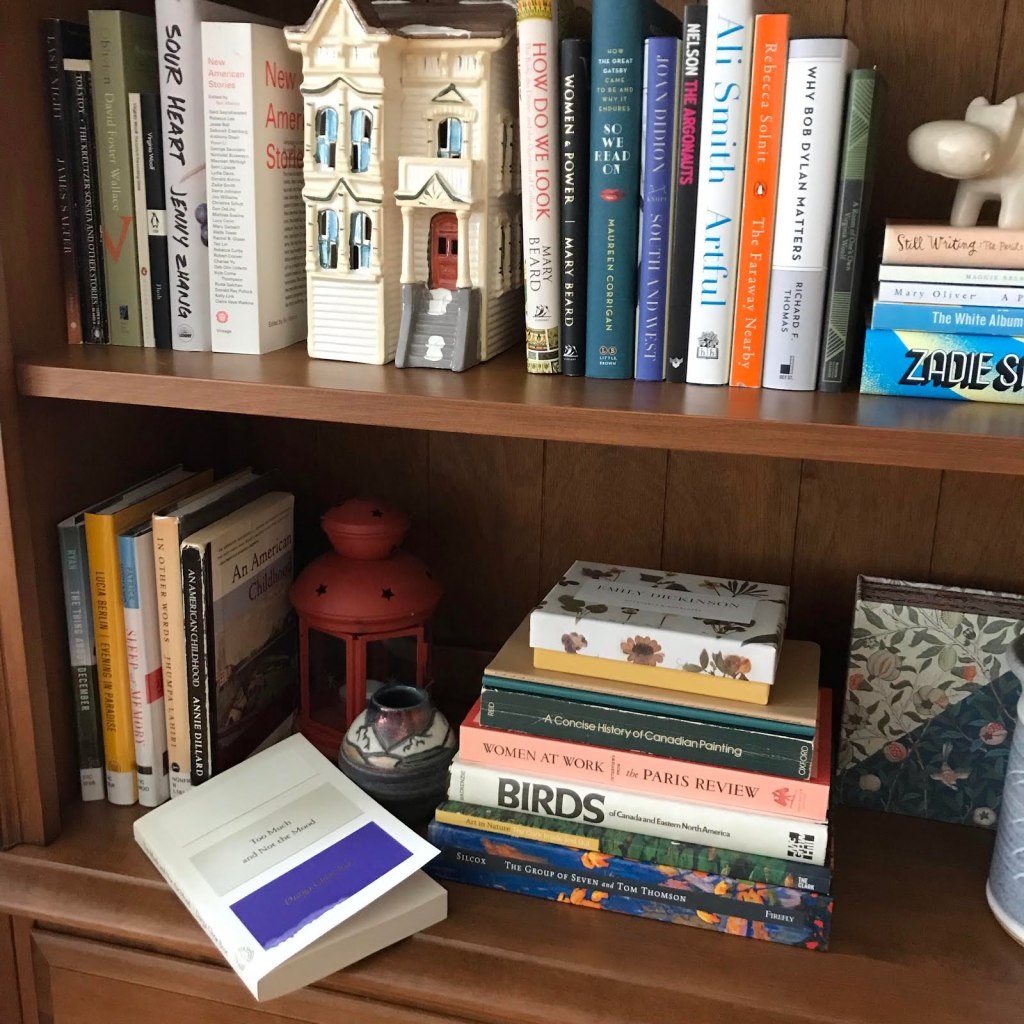
Yesterday, November 19th, large clumps of snowflakes fell in the morning, ones that are so thick they look like cotton balls drifting down to the ground. A snowfall which is beautiful if you are inside, bundled up in your warmest and oldest clothes, with a hot cup of tea, and soup on the stove, but it is heavy and weighs on everything if you are outside: this is winter in the city. I had just received a new bookcase, it was standing empty next to my desk and I started thinking about which books I wanted to put on its shelves. This is a prime peace of real estate: next to my desk. It’s a place that I always see, that I work next to, and that will either make this workspace more enjoyable, or, well, not. Location, location, location. Whatever books move into this bookcase had to be chosen carefully and selfishly. Maybe I should have placed the “old books” there, the literary criticism, would this make me look like a serious reader? But I decided to choose books that I loved, genres that have been important to me, authors that had an impact and influence on how I thought, how I looked and saw what surrounded me, and who I was. All of Hemingway’s work is on the top shelf, from a book on his cats (yes, every cat he owned or was photographed with is in that book), to collections of his short fiction, to his novels, organized by date of publication. He was the first important author in my life, he was the one that made me re-discover reading and my love for it back in 2013 when I read “Hills Like White Elephants,” and my favourite: “A Clean, Well-Lighted Place.” I read so much as a child, but come high school, I read for my English class and that was all. Then, Hemingway, and I found once more that girl inside of me who would lie in a tent at her cottage, in her sleeping bag, first thing in the morning, reading the Magic Treehouse series.
Second shelf: short stories. Collections I’ve read and collections that are waiting for me. From post-war Fitzgerald, to Joyce’s haunted snowy nights, to Amy Hempel’s fragments, to Canadian author Lisa Moore. They flow onto the third shelf, held up by a snowy townhouse bookend, a piece I always loved when it belonged to my parents. On the other side: essays. From one favourite since I read the last line of The Year of Magical Thinking: Joan Didion, to Zadie Smith, whose voice I can hear so clearly when I read her work, to Maggie Nelson’s genre-bending prose (poetry?) on the colour blue in Bluets, a work which I cannot wait to pick up and savour again. The bottom shelf has the library books that I am currently borrowing, along with some more decorative, but no less important collections, Emily Dickinson cards and William Morris postcards.
I look at these books and I want to sit down and write at my desk. A part of me thinks that I am writing this post, after not writing a single word here since September, because they have all coaxed me to sit down and type. There are moments when I walk into my place and detach myself from it, I pretend that I am walking into a friend’s apartment, and I realize what my library must look like to others. There are many books, but if you tied a scarf around my eyes and asked me to find a book for you, I could do so easily, as if I didn’t have anything temporarily blinding me. There is no proper way to organize books, and there is no way to organize them so that you will find them more easily, If you gather them in a way that makes sense to you, you will know where everything is. This library, this extension of you, should be just that, something that you organize as selfishly as possible, for you and you alone. Dress it, decorate it, disorganize and reorganize it, each book has its own home and its own place, and once you’ve found it, you will be the happiest landlord with the most pleasant tenants.

 Sydney K Erickson
Leave a comment