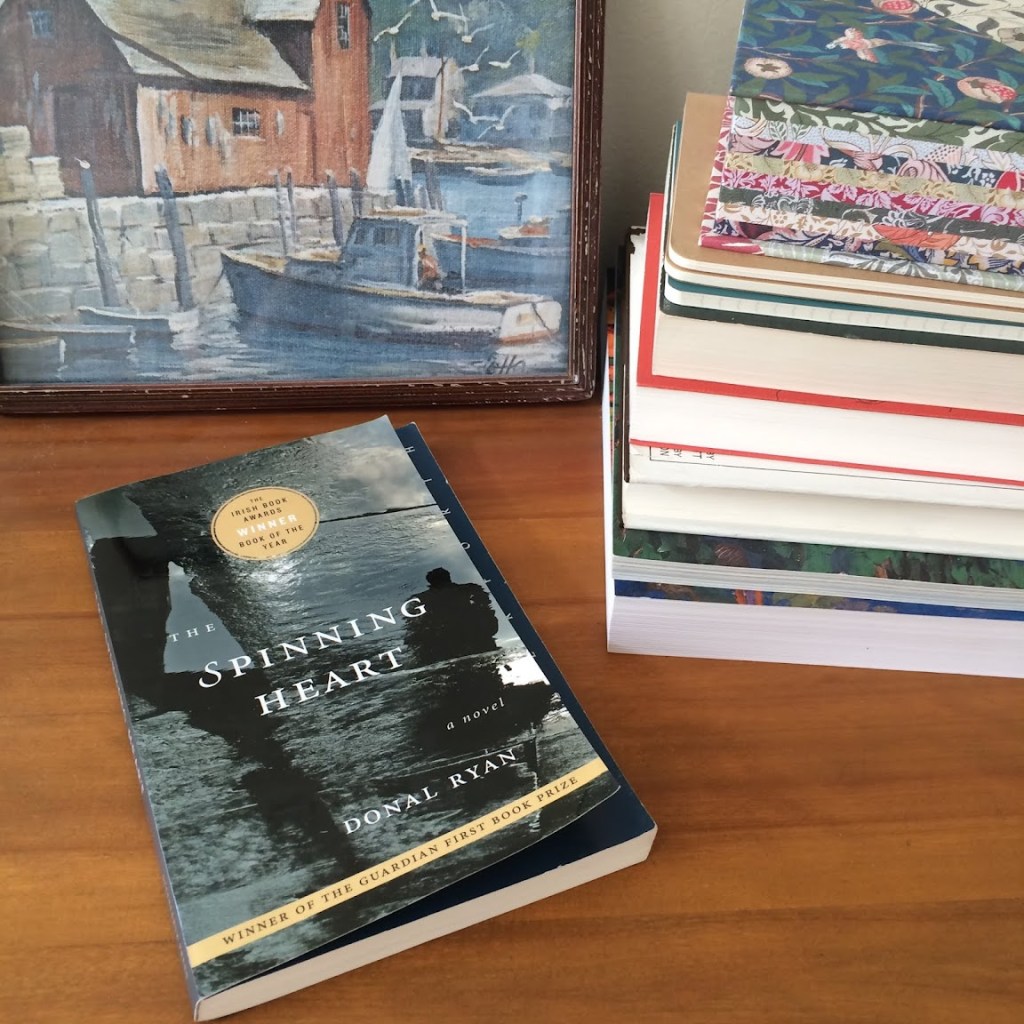
It was on my reading list two years ago for an Irish Literature course that I was taking in university. The two novels, Donal Ryan’s The Spinning Heart and Anne Enright’s The Wig My Father Wore, were assigned at the end of the semester. A time when stress-levels were high, Christmas was so close that all the radio stations were playing those songs that were favourites during the holiday season and annoying during the rest of the year, a time when you were writing your Christmas list, jotting down gift ideas that suddenly came to you while studying for an exam that was days (or hours) away. With my final essays due and my exam binder waiting to be revised, I knew that I wouldn’t get to either of the novels. I attended class and was lost in the lecture (a quick synopsis read online is never ideal), but I was intrigued by what my professor and other students had to say. I kept both novels in my library and recently put them aside with the other Irish writers that I am hoping to read this year. That is a goal of mine: to read more contemporary books by Irish authors. My first “Irish read” was Colm Toibin’s Brooklyn, and my second was Donal Ryan’s The Spinning Heart, and what an unbelievable experience that book was… a note to my professor: while I am two years late, this was a wonderful book to select for our reading list!
Ryan’s debut novel is set in an Irish town following the financial collapse, but when reading his novel, it is as though you are walking through this town. You are knocking on people’s doors, speaking to them, being welcomed into their lives, or simply observing them from a safe distance. You become the outsider in the town, and yet, in every short chapter, which introduces a new character and a new voice every time, you feel a certain intimacy. You spend an average of five pages with each character, such a short time, but Ryan manages to create a unique voice, each one drawing you in, holding your attention, and by the end of the chapter, you have a new perspective, a new piece of the town. It is not so much that they are pieces of a puzzle, but rather, in my mind, pieces of a portrait.
When I was doing research on The Spinning Heart, I came across a few articles from when it was adapted for the stage. I saw some of the images: actors and actresses each with their own chair, sitting in a circle, facing out. The spotlight was on the character who was speaking, and then it would rotate to the next, and so on. I thought “perfect!” they are presented to the audience, as if the audience were to paint them and they are sitting for their portrait, but instead, they don’t have to remain still, they may talk, yell, brood in silence, stand up, walk around, or stare back at them. And this is how I imagined the writing process: Ryan picturing a character sitting in front of him, developing that individual in an intense few pages that is then passed on to us, the reader, and we then listen to, witness, or move into the character ourselves. I am still so impressed by the delicacy, the realism, and the force with which Ryan has written these characters, these numerous voices and lives which each paint their part of the canvas, and of the larger portrait of their town.
I, very briefly, want to write about the idea of home and land in the novel, which seem so unknown and broken, and yet hold within them a sense of belonging. In the opening page, we have the first reference to the novel’s title:
“There’s a red metal heart in the centre of the low front gate, skewered on a rotating hinge. It’s flaking now; the red is nearly gone. It needs to be scraped and sanded and painted and oiled. It still spins in the wind, though. I can hear it creak, creak, creak as I walk away. A flaking, creaking, spinning heart.” (9)
While the “english literature major” in me wants to analyze these lines and write a whole essay about them, I’ll do my best to be concise. When I first read this passage, I thought it was a beautiful description of something that was decaying. Now that I have finished reading the novel, I realize that it is less about something that is decaying, and rather about something that is still alive, although barely, it is still spinning and moving, and therefore living. While this heart is trapped in the gate, while it is unattractive and falling apart, all it needs is attention. It still moves in the wind, and it still speaks through its creaking in the breeze. This idea kept returning to me throughout the book, this idea of being stuck, a sense that things are not good but that those same things are still moving, that there is still a feeling of belonging to something which seems to have been lost.
The ghost estates that we walk amongst through our reading are a reminder of this sense of loss, a physical consequence of the financial collapse. The tension and aggressive, at times violent, encounters or scenes that occur throughout the novel may be traced back to this feeling of decay, one which seems irreversible. And the question remains at the end of the novel: who or what will come along to sand, paint, and oil the spirit of this town so that it is not barely alive, but living?
And when I write that question, I think, but there is still a sense of community, of truth, and of a concern for another that is subtle, but constant throughout the novel. While it may seem like this town, this home, has betrayed those who live there, with the dangers and loss of control that arise following the collapse, the land and the hope for the return of a sense of place is what forces these characters to remain.
One of my favourite passages from the novel is from Vasya’s chapter:
“I’ll sort you out next week, okay? Sort you out means pay you in this land. He looked at me and smiled as he drove. I knew he was lying. I knew I would not see him again. But I said okay, Pokey, okay, and I smiled back, and my stomach lurched as he drove too fast down into a valley that I didn’t know was there.” (41)
Amongst the many voices, that of Vasya’s, an immigrant, was the one which was most poetic and observant for me. The image at the end of this passage is one which I continue to think about: the land consuming someone, changing before one’s eyes, a magician performing a disappearing act. Initially, it communicated a fierce, unwelcoming, and dangerous landscape, but by the end of the book (once you’ve met the characters and know Pokey), the land almost acted in defence of its residents, taking what had to be taken in exchange for a small sense of hope for the town’s future.
Donal Ryan has written a short story collection and three other novels, the most recent of which, From a Low and Quiet Sea, has been longlisted for the Man Booker Prize. While I urge you to start with The Spinning Heart, I am confident that his other works are just as impactful and impressive. As I read his debut novel, I knew that he would be an author that I would return to, one whose work would be a constant and enjoyable presence in my life, and for the rest of my life. I do hope you will cherish this book as much as I have and will.
 Sydney K Erickson
Leave a comment